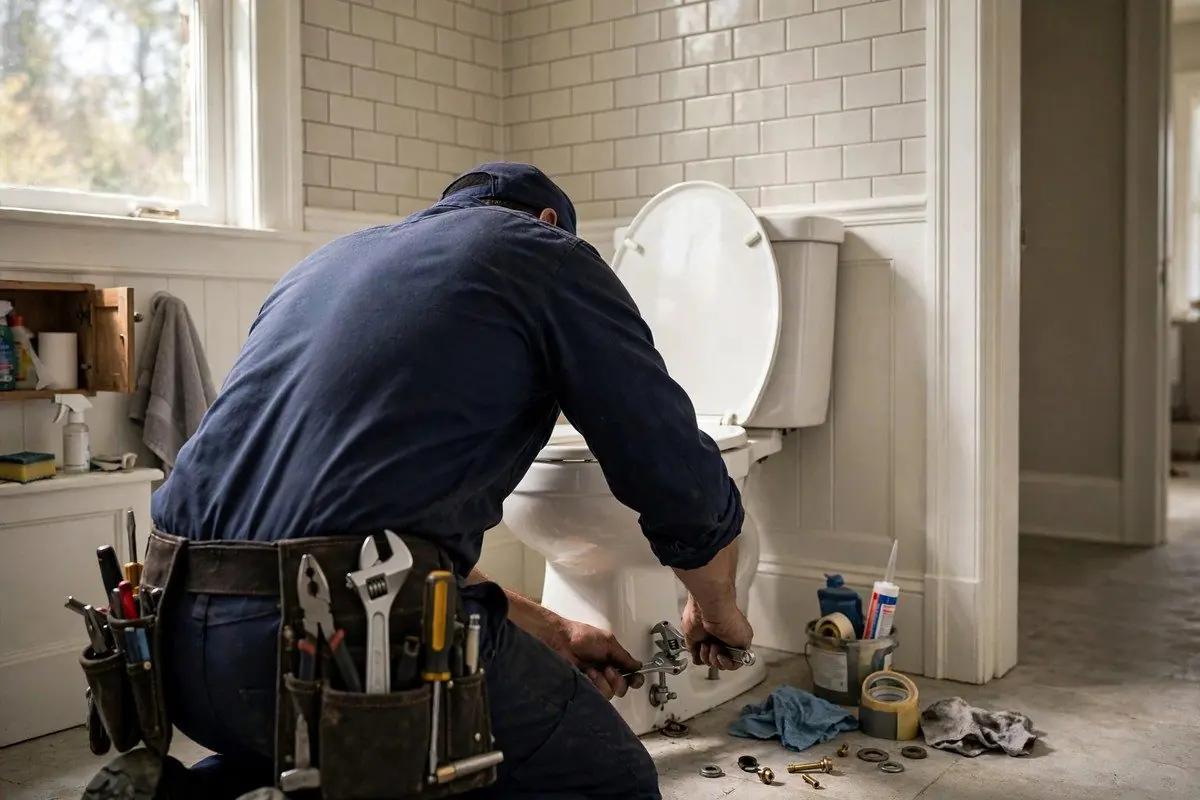
If the bowl is about to overflow
Act in this order and the floor stays dry.
Stop the refill
Take the lid off the tank and press the rubber flapper into its seat, or lift the float arm so no more water enters the bowl.
Close the shutoff
Turn the small oval handle on the wall or floor behind the toilet clockwise until it stops.
Lay down towels
Put towels around the base. Move rugs and anything electrical out of the room.
Do not flush
Every extra flush sends more water to the same blocked spot. Wait until the clog is cleared and the level drops.
If water is already on the floor and spreading, keep your family out of that room. Sewage-tinged water is not safe to touch with bare hands.
Picking the right tool for the clog
The wrong plunger just moves air around. Use this to match the tool to the job.
| Tool | Best for | Notes |
|---|---|---|
| Flange plunger | Standard toilet bowls | Has a soft rubber sleeve that folds out to seal the drain opening |
| Cup plunger | Sinks and tubs | Flat bottom, does not seal well in a toilet bowl |
| Closet auger | Clogs plunging will not move | A short cable with a protected tip that will not scratch porcelain |
| Wet and dry vacuum | Standing water and some blockages | Use only if you know the machine's limits and wear gloves |
| Drain snake from a hardware store | Not recommended for toilets | A long cable can scratch the bowl and jam in the trap |
Plunging step by step
Fit the flange plunger so the sleeve sits inside the drain opening and the cup covers it fully. The bowl needs enough water to cover the cup. If it is low, add water from a bucket.
Push down gently the first time to push the air out, then pull up and push down in a steady rhythm for about 20 seconds. The upstroke does as much work as the downstroke. Break the seal, and if the water drops quickly, the clog is clear.
When the water level stays high
If the bowl does not drain, repeat for another few rounds. After about 15 minutes of steady effort with no change, stop. The blockage may be a toy, a wipe wad, or a problem further down the line.
Test the flush the right way
Do not simply flush and hope. Pour a bucket of warm water into the bowl from waist height. If it drains briskly, you are fine.
Using a closet auger
A closet auger has a hand crank and a curved guide at the end, so it follows the toilet's trap without scratching the porcelain. Feed the tip into the drain opening, then turn the crank while pushing gently forward.
When you feel resistance, keep cranking to hook or break up the blockage, then pull back. Flush once to test. Wear gloves, since the cable will bring up whatever is in the trap.
Keep the handle end of the auger low and the cable straight as you crank, so it does not whip and splash. A good closet auger is about 3 feet long, which reaches past the trap in most homes. If the cable meets a hard stop that will not hook or move, do not force it, because you may have a dropped object wedged in the bend.
Do not try these, even if you saw them online
Several popular shortcuts make a clog worse or hurt the pipes and your skin.
- Chemical drain cleaners, which can sit in a full bowl, splash back on skin, and damage fittings.
- Pouring boiling water into a porcelain bowl, which can crack it.
- Flushing again to see if it will go down on its own.
- Pushing a wire coat hanger down the trap, which scratches and jams.
- Using a long drain snake meant for sinks.
- Plunging when a cleaning chemical is already in the bowl.
Why toilets clog in the first place
Most clogs come from too much paper in one flush, wipes labeled flushable, cotton swabs, or a child's toy. Older low-flow toilets have less flush power, so a single heavy load can stall in the trap.
A toilet that clogs repeatedly with little cause points to a deeper issue. It might be a partly blocked vent, a worn flush valve that releases too little water, a trap with a casting flaw, or a main line that is backing up. A pro can tell which. Persistent cases are a good fit for a toilet repair visit.
When more than one drain is acting up
If the toilet clogs and the tub gurgles, or the shower drains slowly after you flush, the problem is probably past the bathroom. A blockage in the main drain affects every fixture that feeds it. A plunger will not fix that.
Try the lowest fixtures first. If the lowest tub or floor drain bubbles or backs up when you flush upstairs, shut off water use and call for drain cleaning or for main sewer line cleaning. Tree roots and grease are common causes of a main line blockage.
What Altamonte Springs homeowners should know about backups
The City of Altamonte Springs maintains its gravity sewers, force mains, manholes, and lift stations, and lists an after-hours sewer backup line at (407) 571-8686 and Sewer Collection at (407) 571-8533. If a backup affects your whole street, or you see manhole overflow, that is the city side of the problem.
The sources we reviewed do not say where the city's responsibility ends and yours begins, so ask the city before you pay for work on the line outside your house. Mention that call when you phone a plumber, since it helps them decide where to look.
After the clog is gone
Wipe the floor with a household disinfectant and wash your hands well. Run water in the sink for a minute to check that the rest of the plumbing drains normally.
Take the opportunity to fix the cause. Keep a small trash can in the bathroom for wipes and swabs. Teach children what belongs in the bowl. If you live in Maitland or Lake Mary and the same toilet clogs every week, call the 24/7 line before it turns into a flood.
A toilet that overflowed onto a hard floor should be dry within a day. Carpet or drywall that stayed wet longer than that can grow mold, so lift the baseboard edge and look. Photograph any damage before you clean, in case you need it later.
Clogged toilet questions
No. Each flush adds water above the blockage. Stop flushing, close the shutoff valve behind the toilet, and clear the clog first.
It is a poor choice. A flat cup plunger does not seal in the bowl. A flange plunger has an extra sleeve that fits into the drain opening.
Try for about 15 minutes in steady rounds. If nothing changes, switch to a closet auger or call a plumber.
It is risky. The product can sit in the bowl, splash during plunging, and harm fittings and skin. Plumbers rarely recommend it for toilets.
The city lists an after-hours sewer backup line at (407) 571-8686 and Sewer Collection at (407) 571-8533. For a clog inside your house, call us at (407) 964-8940.