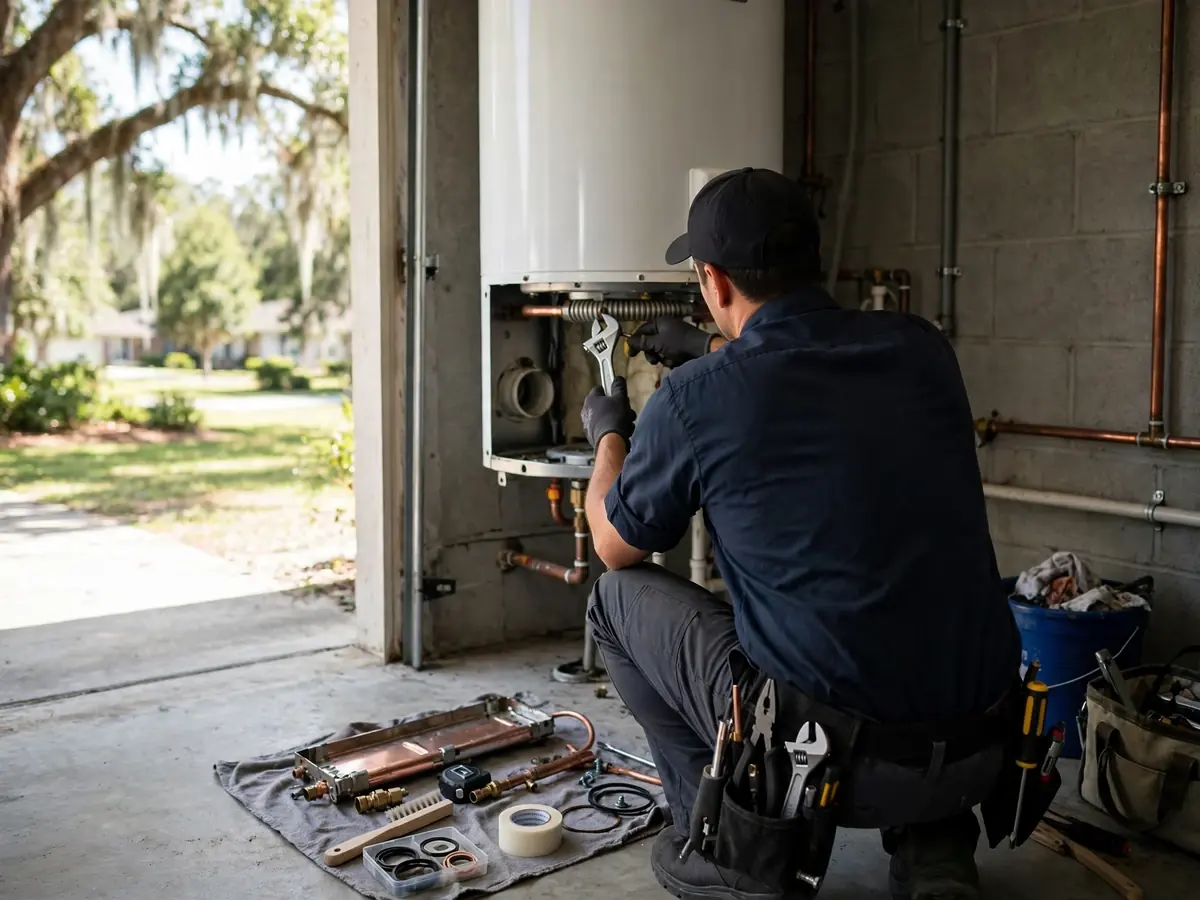
Water heater leaking or dead right now? Start here
Close the cold supply valve
Find the shutoff on the pipe entering the top of the tank and turn it clockwise until it stops. This ends the flow feeding the leak.
Cut the power or the gas
For an electric heater, switch off its double-pole breaker (usually 30 amps) in the panel. For a gas heater, turn the control knob to off. If you smell gas, leave the house, call 911, then call the gas utility number on your bill.
Stop the water from spreading
Move boxes and stored items off the floor. Use a wet vac or towels. A tank can release 40 to 50 gallons, so act on the floor early.
Take photos and note the label
Photograph the leak spot, the rating label, and the pipes around it. The label shows the model, size and manufacture date. That helps us bring the right parts on the first trip.
Call (407) 964-8940 any hour, including nights and weekends. If the water is heading toward electronics or a bedroom, say so first and we will route the call as urgent.
Why a tank water heater stops making hot water
Most no-hot-water calls come down to a short list of failed parts. On an electric tank, two 4,500-watt heating elements, each with its own thermostat, do the work. If the upper thermostat or the high-limit reset trips, the whole tank can go cold. If only the lower element dies, you get a few minutes of hot water and then lukewarm.
A gas tank relies on a pilot or igniter, a thermocouple or flame sensor, and a gas control valve. A weak flame sensor shuts the burner down within seconds because the control cannot confirm fire. A blocked flue or a closed combustion air path does the same thing for safety reasons.
Reading the symptoms: what each one usually means
Water on the floor does not always mean a bad tank. A loose fitting, a weeping valve or a dripping supply line can look the same. If the water seems to come from a pipe rather than the heater, a leak detection visit can trace it before anyone opens a wall.
| What you notice | Likely cause | Usual fix |
|---|---|---|
| No hot water at all, electric | Tripped high-limit, failed upper thermostat, or dead element | Reset test, then replace thermostat or element |
| No hot water at all, gas | Pilot out, bad thermocouple or flame sensor, failed igniter | Clean or replace the sensor, relight, test draft |
| Lukewarm, runs out fast | Failed lower element, broken dip tube, heavy sediment | Replace element or dip tube, flush the tank |
| Water dripping from the side or valve | Faulty temperature and pressure relief valve, or high pressure | Replace valve, test pressure, check expansion tank |
| Water at the base of the tank | Corroded tank shell or failed drain valve | Drain valve swap if fitting, tank replacement if shell |
| Rotten egg smell from hot taps only | Reaction in the tank, often at the anode rod | Flush, swap anode rod, disinfect the tank |
Warning signs you can spot in the garage or closet
Most heaters give some notice before they quit. Check these once a season, and call if you see more than one.
- Rust-colored streaks or flaking paint near the bottom seam of the tank.
- Water stains or a soft spot in the drain pan or the floor under it.
- A discharge pipe from the relief valve that is wet or crusted with minerals.
- Rumbling or popping while it heats, which points to sediment.
- Hot water that is now brown or orange for the first minute.
- A tank label showing a manufacture date more than 10 years back.
Gas, electric and hybrid heaters: what we repair on each
Gas tank heaters
We test the thermocouple's millivolt output, clean the burner and flame sensor, check the draft at the flue, and replace gas control valves when they fail. We also check the venting, because a heater that backdrafts is a safety issue.
Electric tank heaters
With a meter on the terminals, we check each thermostat, each element and the high-limit. A shorted element can trip the breaker again and again.
Hybrid heat pump heaters
These add a compressor, a fan and an air filter on top of the tank. We handle the plumbing side, the condensate drain and the electric backup elements. Sealed refrigerant work may belong to the manufacturer's service channel, and we will say so up front.
Repair or replace: where we draw the line
A good rule is to repair when the tank shell is sound and the failed part is cheap compared with a new unit. Thermostats, elements, thermocouples, relief valves and anode rods all fit that rule. A tank that leaks from the shell cannot be patched, because the steel liner has failed from the inside.
Age matters too. Tanks usually last 8 to 12 years, and a heater past 10 that needs a gas valve or a second repair in a year is often better swapped. When that is the honest answer, we will say so and walk you through replacing the whole unit with the price first.
What a water heater repair costs and why it varies
The part is only one piece of the price. Access, the heater's age and how many trips we need all move the total.
| Repair | Typical ballpark |
|---|---|
| Thermostat or element, electric | $150 to $350 |
| Thermocouple, igniter or flame sensor, gas | $150 to $400 |
| Temperature and pressure relief valve | $150 to $300 |
| Anode rod replacement | $200 to $450 |
| Gas control valve | $350 to $700 |
- Which part failedA thermostat costs far less than a gas control valve. The part and its availability set the base.
- Fuel type and brandSome gas controls and hybrid boards are proprietary and cost more than universal parts.
- AccessA tank in an open garage is simple. One in a tight attic or closet takes longer to reach.
- After-hours timingNight and weekend calls may cost more than a weekday appointment, and we state that before dispatch.
Those figures are typical ballparks, and they change with the job. You will hear the exact price for your heater before we start work, and nothing proceeds without your yes.
Altamonte Springs garages, closets and storm season
Hurricane Ian (September 29, 2022) pushed the Little Wekiva River to record levels, and Hurricane Milton (October 14, 2024) sent it over its banks again. A gas control valve or igniter that sat in floodwater can corrode inside and fail weeks later, so ask for it to be inspected before you trust the heater again.
Altamonte Springs has 97 multifamily communities next to its 137 single-family subdivisions, and many apartments and condos keep the heater in a shared closet or a stack. If you rent, report a leak to your property manager first. We repair heaters you own, and we work with managers who call us in.
The city draws water from the Floridan aquifer and aerates it to cut hydrogen sulfide. A sulfur smell from hot taps only is usually the heater itself, not the supply. We also dispatch to Lake Mary homes in the Heathrow area when the schedule allows.
Repairs on a tank follow the manufacturer's instructions and the Florida Building Code, Plumbing, an adaptation of the IPC, especially for relief valves and discharge piping.
What we do not repair, and who to call instead
A gas smell is not a repair call. Leave the building, call 911, then call the gas utility number on your bill. We will come after the area is cleared.
We do not rebuild tankless units under factory restrictions, and we are not electricians for panel faults. If a breaker trips again right after we test an element, we will say so, and a tankless water heater service call is booked separately. Low water pressure at the street is a utility matter, so Water Distribution at (407) 571-8340 is the right call for that.
Water heater repair questions we hear most
Yes. The 24/7 line at (407) 964-8940 is answered around the clock, and we dispatch for active leaks and no-hot-water failures at any hour. After-hours pricing is stated before the truck rolls.
Dry the tank and the pipes with a towel, then wrap dry paper towels around each fitting and watch. A drip at a pipe connection or the relief valve is often a cheap fix. Water running from the bottom seam or out of the jacket usually means the tank has failed.
Only if your heater's label gives instructions, you smell no gas, and the pilot stays lit. If it will not stay lit, the thermocouple or flame sensor is likely worn. Do not hold the knob down past the label's time or defeat any safety.
On an electric tank, the lower element is often dead, so only the top third heats. On gas, sediment can smother the burner, and a broken dip tube mixes cold water into the top. A technician with a meter can tell which in a few minutes.
Yes. Close the cold supply valve and switch off the breaker or gas control. Running a leaking tank empty can burn out an electric element in minutes.