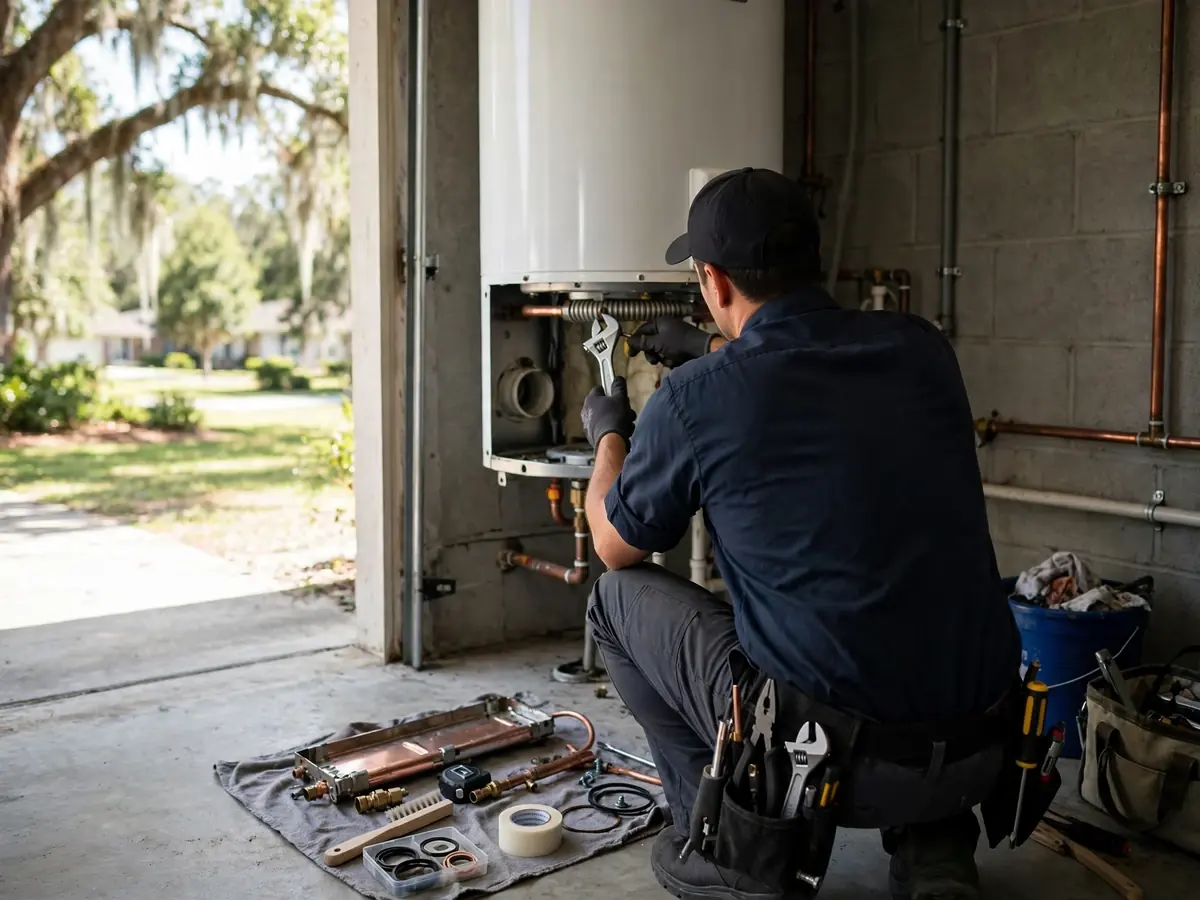
What the noise is telling you
Sediment builds slowly. Every time cold water enters the tank, dissolved minerals can drop out and sink. After months or years, a layer an inch or more thick can cover the bottom, where the gas burner or lower electric element does its heating.
Water trapped under that layer overheats and flashes to steam. Each bubble that breaks through the sediment makes a pop or a rumble, like a pot of boiling pasta. The sound is loudest right after the heater cycles on.
Gas tanks tend to be louder because the flame heats from below, but electric tanks do it too, where sediment buries the lower element.
Noise decoder: what each sound usually means
Not every sound is sediment. Match what you hear to the likely cause.
| Sound | Likely cause | What to try |
|---|---|---|
| Popping or rumbling when heating | Sediment on the tank floor | Flush the tank |
| Ticking in pipes after use | Pipes expanding as they cool | Usually harmless, check pipe straps |
| Sizzling or hissing | Water dripping on a hot burner or element | Look for a leak, call a plumber |
| Screeching or whistling | Partly closed valve or scale in a fitting | Check valves, then call |
| Hammering when a tap shuts | Water hammer from fast valves | Install an arrestor, call a plumber |
| Loud boom or steam burst | Overheating, a safety problem | Shut off and call at once |
How to flush the tank safely
Flushing takes about an hour. Wear gloves, because the first water out can be scalding.
- Turn the electric breaker off or set the gas control to pilot or off.
- Close the cold water inlet valve above the heater.
- Open a hot tap upstairs so air can enter the tank.
- Attach a garden hose to the drain valve and run it to a floor drain or the driveway.
- Open the drain valve and let the tank empty, watching for sand-like grit.
- Briefly open the cold inlet to stir the bottom and flush more sediment out.
- Close the drain, refill with the hot tap open, and restore power or gas only after the tank is full.
When flushing will not fix it
If the drain valve clogs with sediment, flow stops and the tank stays dirty. A stuck, hard layer may need the valve replaced or a long hose wand to break it up. Forcing a stuck plastic valve can break it and leave the tank half drained.
Tanks that have run 10 years or more may carry a layer that is too hardened or too deep. A rusty flush stream is another bad sign, because it means the tank steel is going. In those cases a repair visit or a replacement tank usually beats repeated flushing.
A flush that cleans out a lot of white chips and grit is a good sign. It means the noise should drop within a day.
The anode rod and the tank's lifespan
Inside the tank hangs a rod of magnesium or aluminum. It corrodes on purpose, so the steel tank does not. When the rod is used up, the tank starts to rust from the inside.
A technician can pull the rod and check it. A pencil-thin rod with bare steel showing is worn. Swapping it can add years of life to a tank that is not yet leaking, but only if the tank is otherwise sound.
The rod is also why a rotten egg smell appears in some heaters. Bacteria feed on hydrogen sulfide and the rod's reaction, so if you notice that smell with the noise, mention it.
A relief valve and its discharge pipe are required by the state plumbing code, which is modeled on the International Plumbing Code (IPC), which is why they should never be capped or plugged.
When a popping tank becomes dangerous
Treat the following as urgent.
The T&P valve is discharging
A steady or intermittent drip from the temperature and pressure relief valve's pipe means the tank is over temperature or pressure. Turn off power or gas and call. Never cap or plug the valve.
Steam, scalding water, or a loud boom
Stay away, shut off power or gas if you can reach it safely, and call 911 if there is any fire or injury risk.
Gas smell near the heater
Leave the house, do not use switches, and call 911, then your gas utility using the number on your bill.
Water pooling at the tank base
Close the cold inlet, turn off power or gas, and call. A leaking tank cannot be repaired.
Call (407) 964-8940 at any hour for any of these.
What Altamonte Springs homeowners should know about tank sediment
Your tap water comes from the city's own wells, which pull from the Floridan aquifer, and the treatment steps include aeration trays and a corrosion-control additive. In the city water quality pages we read, no hardness number appears. That means we cannot say how quickly a layer of scale will form in your tank.
A hardness test strip from a hardware store settles the question in a minute. Harder readings call for a flush more often, while soft readings let you stretch the interval. You can also phone the water office at (407) 571-8340 and ask where hardness data is posted.
What a noisy-heater visit can cost
A flush by a plumber is typically a small service charge. An anode rod swap, a drain valve replacement, or a new T&P valve each add their own parts and labor. Typical ballparks are about $100 to $250 for a flush, $150 to $400 for an anode or valve job, and more for a new tank. These change with the job.
You hear the number first, then choose between repair and a new tank.
- Tank ageOlder tanks may not be worth repair spend.
- Gas or electricDifferent parts, different labor.
- LocationA tank in a tight closet or attic takes longer.
- Valve conditionA seized drain valve adds a new part.
If the tank is past repair, our repair team will say so honestly, and a tankless unit is an option worth a look for homes that want the space back.
Prevention and when to call a plumber
Flush once a year, and every six months if your water leaves heavy grit. Test the T&P valve by lifting its lever for a second, with a bucket or the pipe aimed at a drain. Keep the area around the heater clear.
Call a plumber if you do not trust your hands with gas, if the unit sits in an attic, or if the tank is past about 10 years. A technician in Winter Springs or Maitland can reach you the same day when the schedule allows.
Noisy water heater questions
Rarely. Popping is usually sediment. The danger comes from a faulty relief valve or overheating, so check the T&P valve and shut off power if it discharges.
A common habit is once a year. If your water leaves heavy grit, do it every six months.
No. Tankless units are descaled with a pump, hoses, and a descaling solution, not drained like a tank.
It can expose existing weak spots, because sediment sometimes plugs a pinhole. If the tank is old, be prepared for a leak, and think about replacement.
The city publishes an annual drinking water quality report on its website. It describes the groundwater source and treatment, but we did not find a hardness figure in it.
If the noise is mild, you can keep using it until a flush is scheduled. If it is loud, hissing, or leaking, turn off the power or gas.