A drain line backup that cannot wait
Backups that return every few weeks or fill a whole level of the house are the usual reason people call for jetting. Here is how to hold the situation while a crew is on the way.
Shut down every fixture
Stop the washer, dishwasher and showers. A full line has no room for more, and water will find the lowest drain in the house.
Find the cleanout
A white or black 3 or 4 inch cap in the yard, garage wall or beside the foundation is the cleanout. Do not open it if water is standing close to the top.
Protect the floor
Lay towels at the lowest drain and lift rugs, boxes and electronics. Wear boots or gloves if you touch wet areas.
Note what you see
Take photos of any overflow and write down which fixtures gurgle first. The pattern helps the technician choose the entry point.
We run jetting calls at night and on weekends. Same-day visits are offered when the schedule allows, and active overflows move to the front of the list.
How a jetter actually clears a pipe
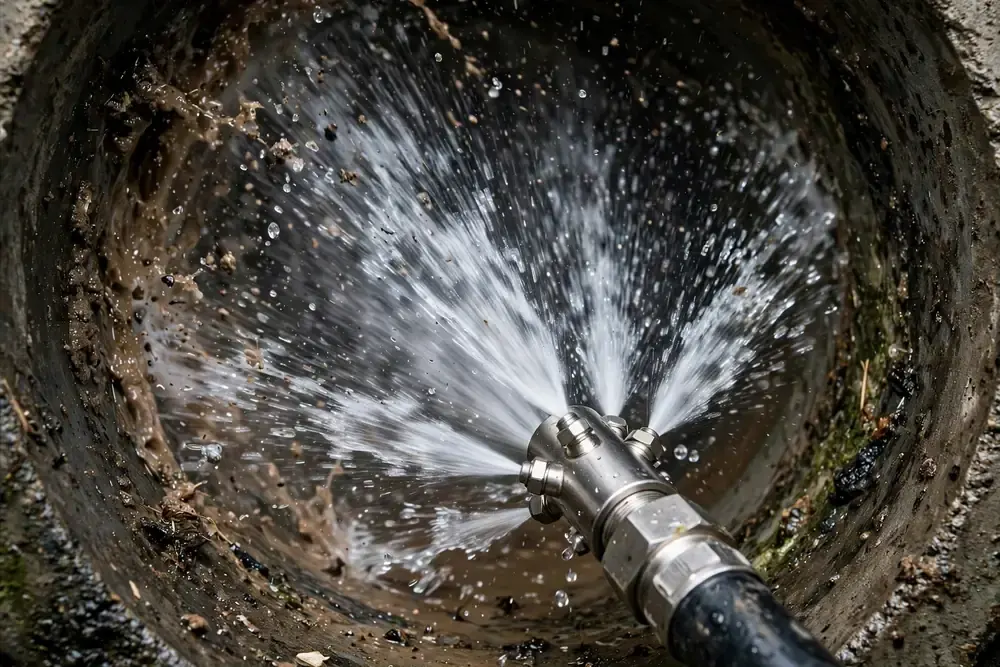
A typical jetter pumps 4 to 8 gallons of water per minute at 1,500 to 4,000 psi through a hose with a small nozzle on the end. Most of the water jets backward, which pulls the hose forward along the pipe and pushes debris back to the opening, where it can be flushed out.
A cable only pokes a hole through a clog. Jetting washes the full ring of the pipe, which is why a line that fills with grease every few months often stays open far longer afterward. The result depends on the pipe being intact, so we look inside first.
Jetting versus snaking: which one fits your clog
The two methods solve different problems, and a good technician explains why one makes more sense than the other. A routine kitchen clog is still a drain cleaning job with a cable in most homes.
| Situation | Snake or cable | Hydro jet |
|---|---|---|
| One-time hair or soap clog | Fast and enough | Not needed |
| Grease coat that keeps returning | Opens a hole, coating stays | Strips the wall |
| Fine roots at joints | Cuts the center, stubs remain | Shreds hairlike roots |
| Long sludge deposit in a 4 inch line | Moves it a few feet | Flushes it out |
| Cracked, collapsed or offset pipe | Can snag and break more | Not safe, repair needed first |
When jetting makes sense and when it does not
Jetting is a strong tool, so we check conditions before choosing it.
- Backups come back within 3 to 6 months after cable cleaning.
- A camera shows grease, scale or sludge lining the walls.
- Roots enter at joints but the pipe walls are still whole.
- The line is 3 inches or larger with a cleanout to enter through.
- The pipe is old clay, cast iron with heavy flaking, or Orangeburg: we look first and may skip jetting.
- Cracks, missing sections or sags show on camera: repair comes first.
Grease, roots and scale: what each one needs
Grease builds up in kitchen lines and restaurant drains, hardens as it cools and lines the wall. Jetting with a rotating nozzle at the right pressure softens and lifts it, and a hot-water flush can follow. Roots go after any small gap at a joint, and a nozzle with forward-cutting jets can break them back to the pipe wall.
Mineral scale builds slowly where water leaves minerals behind. Whether your water leaves much scale depends on its hardness, and the city's water report does not list a hardness figure that we can quote here. Ask the water utility if you want a number, or check your fixtures for white crust around the aerator.
Food service and shared lines around Altamonte Mall
The city lists about 50 multi-tenant retail centers, including Altamonte Mall and Altamonte Crossing. Restaurants in strip centers often share a building drain, so grease from one tenant can fill a line that serves its neighbors. If a shop on your row backs up, ask the property manager whether the grease trap has been cleaned.
Our crews run jetting for commercial kitchens as an urgent job when the line is full, and a camera follow-up shows whether the build-up is grease or something else. For a tenant who is unsure who holds the maintenance duty, the lease is the first place to look. We do the same work for shops and offices over in Longwood.
Jetting itself is maintenance, not a code item. If the camera shows a section that has to be replaced, the new pipe goes in to the state plumbing code, which is modeled on the International Plumbing Code (IPC).
Camera before and after
We run a camera into the line before jetting when we can, and again afterward. The first pass shows whether the pipe is a candidate. The second shows that the wall is clear and whether a sewer line repair is the next step because of a crack or sag.
Pipe in your yard sits in sandy soil, and a belly or offset can hold water and waste even when the line is clean. The recording lets you see that, not just hear about it.
What affects the cost of a jetting visit
Jetting costs more than a basic snake because the equipment is larger and the job takes more time. The following factors set the number.
| Job | Typical ballpark |
|---|---|
| Residential branch or main jetting | $350 to $700 |
| Long main line with camera before and after | $450 to $900 |
| Restaurant or multi-unit line | $500 to $1,200 |
- Length and size of the lineA 40 foot run of 4 inch pipe is a shorter job than a 120 foot main with a bend.
- Entry pointA cleanout makes it simple. Pulling a toilet to enter the line adds time.
- Condition of the buildupHard grease and root balls need slower passes with a different nozzle.
- Camera workA pre-jetting and post-jetting recording adds labor but removes guesswork.
- After-hours callA crew called out at night works at a higher rate than a daytime visit.
Those ranges are typical ballparks and they move with the job. You hear the figure before the hose goes in the pipe, and nothing starts until you agree.
Pipes we will not jet, and what happens instead
High pressure can finish off a pipe that is already failing. We do not jet a line that a camera shows is collapsed, badly cracked or fully separated, and we say so plainly. A repair or a trenchless liner is the correct next step, and we also tell you when the problem is on the city side of the line and the city's sewer crews should be called first.
Hydro jetting questions from Altamonte Springs customers
Yes. Our line runs 24/7. If sewage is rising in a tub or a floor drain, call (407) 964-8940 and say so, and we move that job toward the front. Night calls carry an after-hours rate that we state before work starts.
It depends on the pipe. Sound cast iron, PVC and clay without breaks handle it well. Pipe that is cracked, collapsed or badly flaking is not jetted until the camera shows what it can take.
A typical home line is run between 1,500 and 3,000 psi, and we step up only if the nozzle meets a hard deposit. Smaller or older pipe gets less pressure and a gentler nozzle.
It varies with what goes down the drain. A line stripped of grease can stay clear for years. Roots grow back and may need another pass in a year or two, which is why a camera check is useful.
No digging is needed when there is a cleanout. Water and debris are flushed into the line, not onto the lawn.
No. A belly is a low spot in the pipe itself. Jetting can clean out the standing waste but cannot raise the pipe, so a camera and often a repair are the next step.