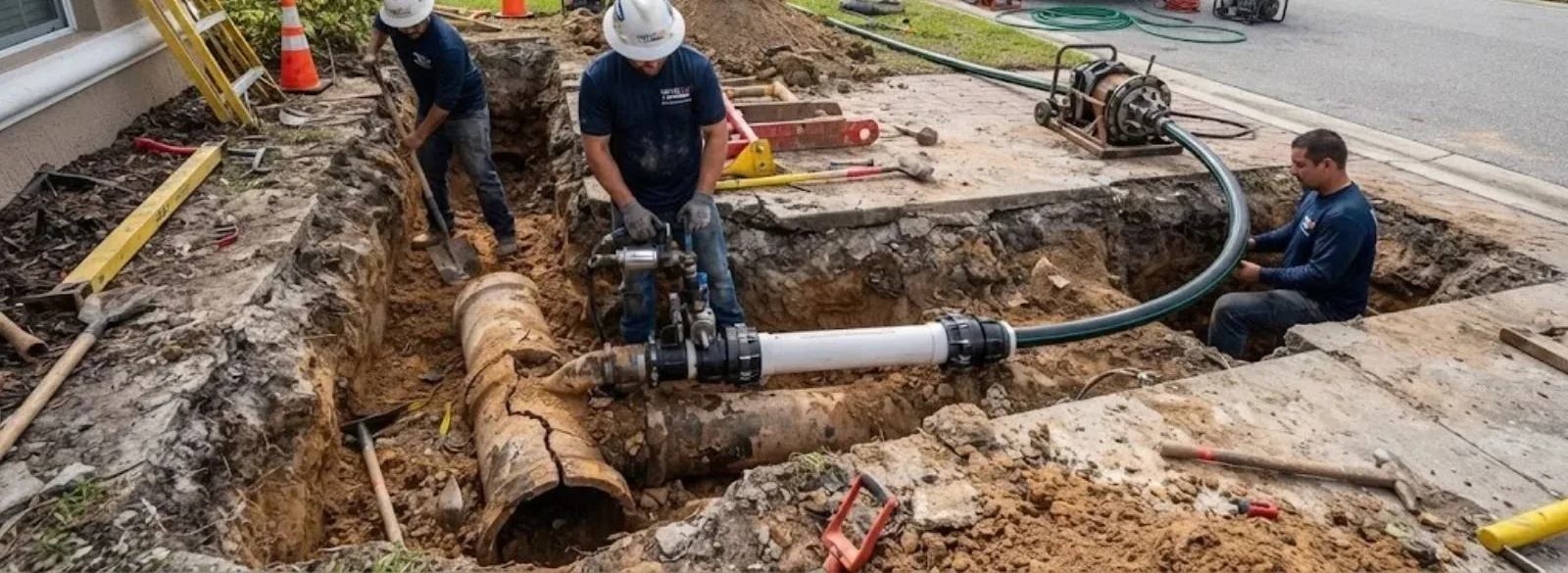
Warning signs the old drain pipe is failing
A failing cast iron line rarely announces itself with one big event. It shows up as several small ones that keep coming back.
- Drains slow down in more than one fixture, and cleaning gives only short relief.
- Gurgling in the tub or toilet after a washing machine or dishwasher drains.
- Sewer odor in the yard, garage, or near a floor drain.
- Sudden green or soggy patches of lawn over the line path.
- Rust flakes or black sludge on the end of a drain snake.
- A crack, a sag, or a damp spot in the slab or crawlspace under a bathroom.
- Repeated clogs that start at the same spot.
What corrosion does inside the pipe
Wastewater is acidic and full of grease, soap, and gases. Over time it eats the inner surface of cast iron, producing a crusty layer called tuberculation. The scale narrows the opening and catches paper and grease like a net.
The outside of the pipe can fail too. Soil moisture, a leaking joint, or shifting ground can crack or break a section. Sandy soil, which UF/IFAS describes as typical across North and Central Florida, drains quickly but can wash out under a pipe after a leak, leaving it without support. Ask your plumber what the camera says about bellies and offsets.
The camera inspection comes first
A plumber feeds a small waterproof camera on a flexible rod into the line through a cleanout, a pulled toilet, or a roof vent. The picture goes to a screen, and a locator at the surface finds the depth and the exact spot of any problem.
You should leave with a recording and notes on pipe material, diameter, scale, cracks, bellies (low spots that hold water), offsets at the joints, and root intrusion. If the camera hits a break it cannot pass, a pro will tell you. A sewer camera inspection is also the right step before you buy a house with old plumbing.
Lining versus replacement: how they compare
Neither is always better. The camera result and the site decide.
| Factor | Pipe lining (CIPP) | Dig and replace |
|---|---|---|
| How it works | A resin-soaked liner is pulled in and cured to form a new pipe inside the old one | The old pipe is excavated and replaced with new plastic pipe |
| Best when | The pipe is intact but rough, with minor cracks or root entry | The pipe is collapsed, badly offset, or has a belly |
| Yard and driveway damage | Small access pits only | Trench across lawn, driveway, or slab |
| Pipe diameter after | Slightly smaller, but very smooth inside | Full size, new pipe |
| Typical ballpark | Often several thousand dollars up to well over 10,000, depending on length | Often about the same or more, plus restoration of landscaping or concrete |
| Time on site | Usually a day or two | Several days, longer under a slab |
When a liner is not the right choice
A liner cannot fix a pipe that has collapsed, because it has nothing to press against. It also struggles with a deep belly that holds water, since the new pipe follows the shape of the old one. Pipes with sharp offsets at joints may need spot digs first.
Active root intrusion needs cutting back before lining. A pro may use a hydro jetting pass to clean the pipe so the liner bonds well. Ask for the camera footage of the final result so you can see the new surface.
What drives the cost of a cast iron repair
Prices vary a lot, so any number you see online is only a ballpark. Treat these as typical ranges that change with the job.
| Repair type | Typical ballpark |
|---|---|
| Camera inspection | Often about 150 to 500 dollars |
| Spot repair of one section | Often about 1,500 to 5,000 dollars |
| Lining a full line | Often about 4,000 to 15,000 dollars or more |
| Full replacement by trench | Often about 5,000 to 20,000 dollars or more |
- Length of pipeCost scales with the number of feet. A single spot repair is far cheaper than relining or replacing a full run to the street.
- Depth and accessA pipe 2 feet deep in a lawn is cheaper to reach than one 6 feet down or under a slab.
- Surface restorationTrench work through concrete, pavers, or landscaping adds cost for patching and replanting.
- Permit and inspection rulesRules depend on the scope of work. The city office that handles plumbing permits is Building and Fire Safety, so call (407) 571-8446 and describe the job.
- Utility locatesDigging requires a call to 811 at least two full business days before work starts.
These are typical ballparks only, not a quote. The price is stated clearly before work starts, and only after a camera tells us what the pipe needs.
What Altamonte Springs homeowners should know about who owns the line
The City of Altamonte Springs maintains gravity sewers, force mains, manholes, and lift stations. The city pages we reviewed do not say where the city's responsibility ends and the homeowner's begins, and nothing there mentions cleanouts or laterals.
So make one call before you spend money. Ask Sewer Collection at (407) 571-8533 who is responsible for the section you are worried about, and ask where the property line cleanout sits. For a backup after hours, the city lists (407) 571-8686. Give the answer to your plumber.
Replacement building sewer pipe is chosen to meet the plumbing code, the state plumbing code, which is modeled on the International Plumbing Code (IPC), so ask the installer which pipe and fittings will be used.
What a homeowner can and cannot do
You can watch for signs, keep grease and wipes out of the drain, and avoid using caustic cleaners on old pipe. You can also locate the cleanout cap, which is a round or square plug near the house or at the property line.
You cannot safely repair a buried or under-slab line without tools, a locator, and the right pipe fittings. Digging near utilities without an 811 locate is a hazard. A pro handles the camera, the dig, and the permit. If the line is blocked right now, sewer line repair crews can clear it first and then plan the repair.
Questions to ask any contractor
Ask for the camera footage before agreeing to a repair. Ask whether the price covers restoration, permits, and a final camera pass. Ask what happens if the crew finds a second problem once the pipe is open.
Check the contractor's state license on the Florida DBPR website, since an unlicensed contractor puts you at risk. Neighbors in Longwood and Maitland can reach the same 24/7 line when a line fails on a weekend.
Cast iron sewer questions
Cast iron is heavy, dark gray or black, and rings when tapped. A magnet will stick to it. Plastic pipe is white, gray, or black and light. A camera inspection confirms the material.
Manufacturers rate liners for decades of service, but results depend on the condition of the old pipe and the install. Ask the contractor about the product and the warranty terms in writing.
A snake can relieve a clog for a while, but it also scrapes the thin walls. If you must snake repeatedly, get a camera inspection.
It depends on your policy and the cause. Many policies exclude wear and tear. Read your policy and ask your insurer before work starts.
The city maintains its sewers, manholes, and lift stations, and the pages we reviewed do not state where the homeowner's part begins. Call Sewer Collection at (407) 571-8533 and ask about your address.