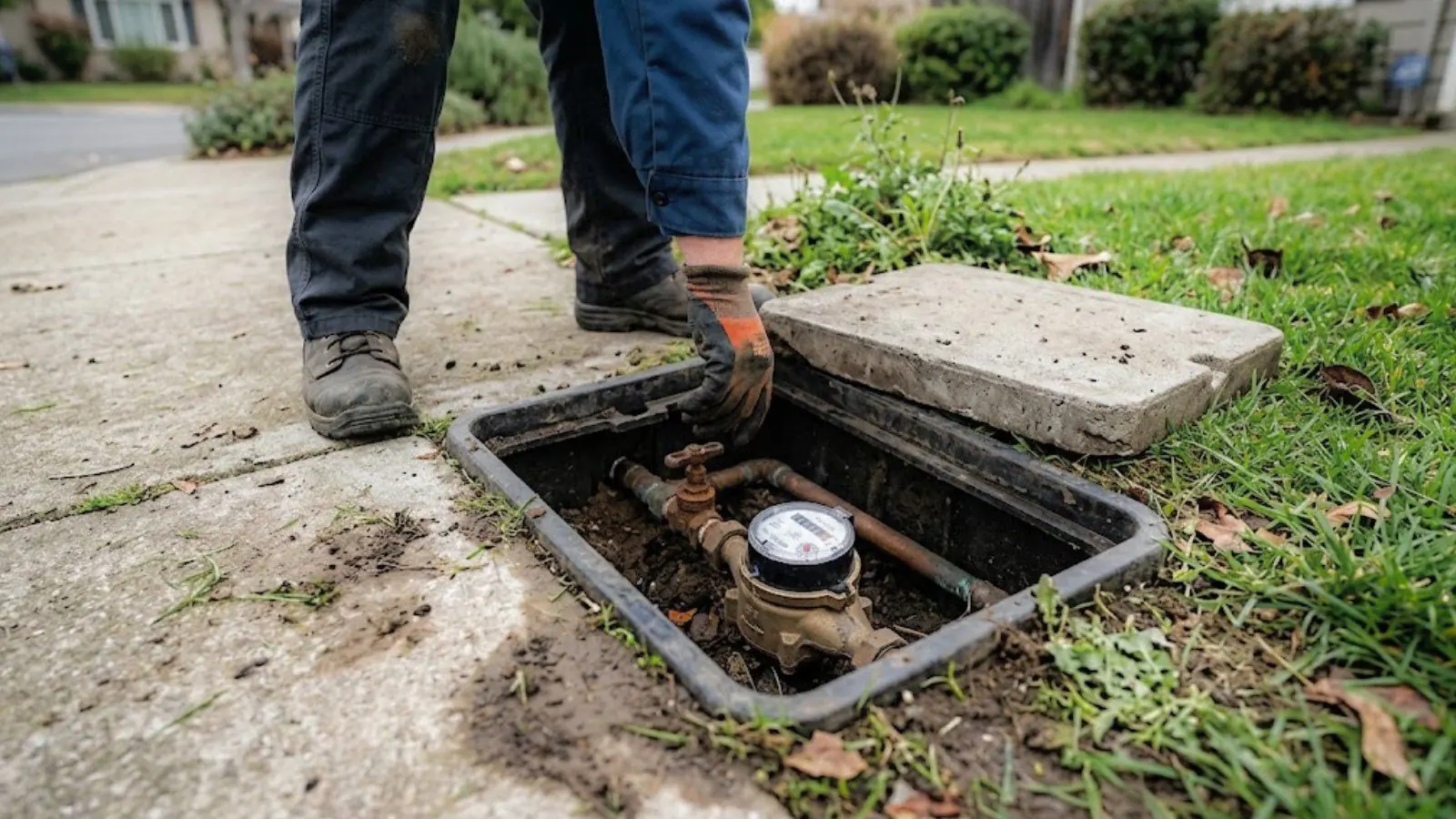
The ten-minute meter test
You need a flashlight, a pen and paper, and a few minutes with no one using water.
- Turn off all faucets, the dishwasher, the washing machine and the ice maker. Do not flush any toilet.
- Open the meter box lid. Use a screwdriver to lift it gently, and watch for insects or spiders before you reach in.
- Find the low-flow indicator on the meter face, a small triangle, star or dial that spins with even tiny flow. If it moves, water is flowing.
- Write down the numbers on the register, and note whether the meter reads in gallons or cubic feet.
- Wait fifteen to thirty minutes without using water, then read it again.
- If the number changed or the indicator moved the whole time, close your home's main shutoff and check again. If the meter stops, the leak is inside the house. If it keeps moving, the leak is on the line between the meter and the house.
Reading what the test tells you
A slow, steady spin usually means a leaking toilet or a dripping valve. A fast spin points toward a broken line, a stuck irrigation valve or a running water heater relief valve. Intermittent movement suggests an automatic device that opens on its own, such as a sprinkler zone or a toilet that refills in cycles.
If the meter is still moving after you close the main shutoff at the house, the leak is outside the walls. That sits on the buried line, and a water line repair visit finds and fixes it. If the leak turns out to be inside, a pressure test with a gauge narrows down which branch is losing water.
The toilet dye test
A silent toilet leak is the most common reason for a spike in use. The rubber flapper at the bottom of the tank wears out and lets water trickle into the bowl. You will not hear it, and the tank refills in short bursts.
Remove the tank lid, add about ten drops of food coloring to the tank water, and do not flush. Wait fifteen to twenty minutes. If color shows up in the bowl, the flapper or flush valve is leaking. A toilet repair often means a new flapper or fill valve, which is a short job.
Where the water usually goes
This table lists common sources of unexplained water use, how to spot each, and who fixes it.
| Source | How to spot it | Typical fix |
|---|---|---|
| Toilet flapper or fill valve | Dye shows in the bowl, tank refills in bursts | Replace flapper or fill valve |
| Irrigation valve stuck open | Soggy lawn, zone runs without a timer call, meter spins | Repair or replace valve, check controller |
| Buried water line leak | Meter moves with main shutoff closed, wet or sunken soil | Locate and repair the line |
| Water heater relief valve | Drip or hiss near the heater, discharge pipe wet | Test valve, check pressure, replace |
| Dripping faucet or hose bib | Visible drip, mineral stains | Replace washer, cartridge or valve |
| Slab or wall leak | Warm floor spot, damp wall, sound of water | Electronic leak detection, then repair |
Checking your irrigation system
Sprinkler systems leak without anyone noticing. A cracked head, a broken lateral line or a valve that does not close fully can run for hours. Turn off the irrigation controller, then close the irrigation shutoff if there is one, and read the meter again.
If the meter stops, the sprinklers are the leak. Walk each zone while it runs and look for geysers, pooled water or dry patches. The St. Johns River Water Management District sets watering limits across the region, and Seminole County has its own rules, so check the current schedule before you run a test.
Ask the city whether your irrigation runs on potable or reclaimed water. The city says reclaimed water travels through the same distribution system as drinking water, so the answer affects which line you are testing.
What Altamonte Springs customers should know about bills and meters
The City of Altamonte Springs supplies drinking water and sewer service and bills for it. Its Water Distribution Division maintains the pipes, valves and meters that deliver water to your property, and you can reach it at (407) 571-8340. If you suspect the meter itself is faulty, that is the office to call.
The city also posts an online Utility Billing Adjustment Request Form. We could not read the policy terms, so ask the city what documents it wants, such as a plumber's repair invoice, and how a leak adjustment is calculated. Keep your repair receipt and the before-and-after meter readings in one folder.
If the leak turns out to be a failed fitting inside the house, the repair is done to the plumbing volume of the Florida Building Code, itself built on the IPC.
Sewer charges may be tied to water use on your bill. Ask the city how irrigation or a repaired leak is treated before you assume the whole bill will drop.
Finding a leak you cannot see
If the toilets are dry, the irrigation is off and the meter still turns, the leak is hidden. A technician uses acoustic listening gear to hear water escaping from a pipe, a thermal camera to see temperature patterns on floors and walls, and a pressure test to isolate each section of line. That is the work of leak detection.
The result is a marked spot on the floor, wall or yard, not a guess. Bring your meter readings and the last few water bills so the technician can see how long the leak has been running.
What finding and fixing a leak costs
These are typical ballparks. They change with access, pipe depth and material. They are not quotes.
| Job | Typical ballpark |
|---|---|
| Replace a toilet flapper or fill valve | $100 to $300 |
| Repair an irrigation valve or line | $150 to $450 |
| Leak detection visit | $150 to $600 |
| Repair a buried water line section | $500 to $2,500 |
- Where the leak isA toilet flapper is quick. A leak under a slab or driveway takes more tools and time.
- Testing timeLeaks in a long buried line take longer to isolate.
- Repair methodDigging and replacing a section costs less than rerouting the whole line.
- Surface restorationConcrete, tile and landscaping are often separate costs.
The price is stated clearly before work starts. If testing finds a second leak, you get the new price before any repair begins.
When the high bill is not a leak
A bill can also rise from real use: a new pool fill, a houseguest stretch, a run of hot days with more irrigation, or a billing period that was longer than usual. Compare the dates on this bill to the last two.
If the meter test passes and the dye test is clear, ask the city to confirm the meter read. Irrigation use tends to climb in dry weather, so check your timer first. Our crews serving Winter Springs and Lake Mary run these tests every week.
High water bill questions
A silent flapper leak can waste hundreds of gallons a day, which adds up quickly on a monthly bill. The dye test takes about fifteen minutes and costs a few cents.
Something is using water. Common causes are a toilet leak, a stuck irrigation valve or a leaking line. An ice maker or a water softener recharge can also cause brief movement, so run the test again.
Yes, if you cannot find the leak quickly. Closing the main stops damage inside the house. If the meter still turns after that, the leak is on the buried line outside, and you should call a plumber.
That depends on how the city bills. Ask the City of Altamonte Springs how irrigation and leaks are treated, since the policy terms were not published where we looked.
Yes. The city has an online Utility Billing Adjustment Request Form. We could not read the policy terms, so call the city's utility billing office or Water Distribution at (407) 571-8340 to ask what proof you need.