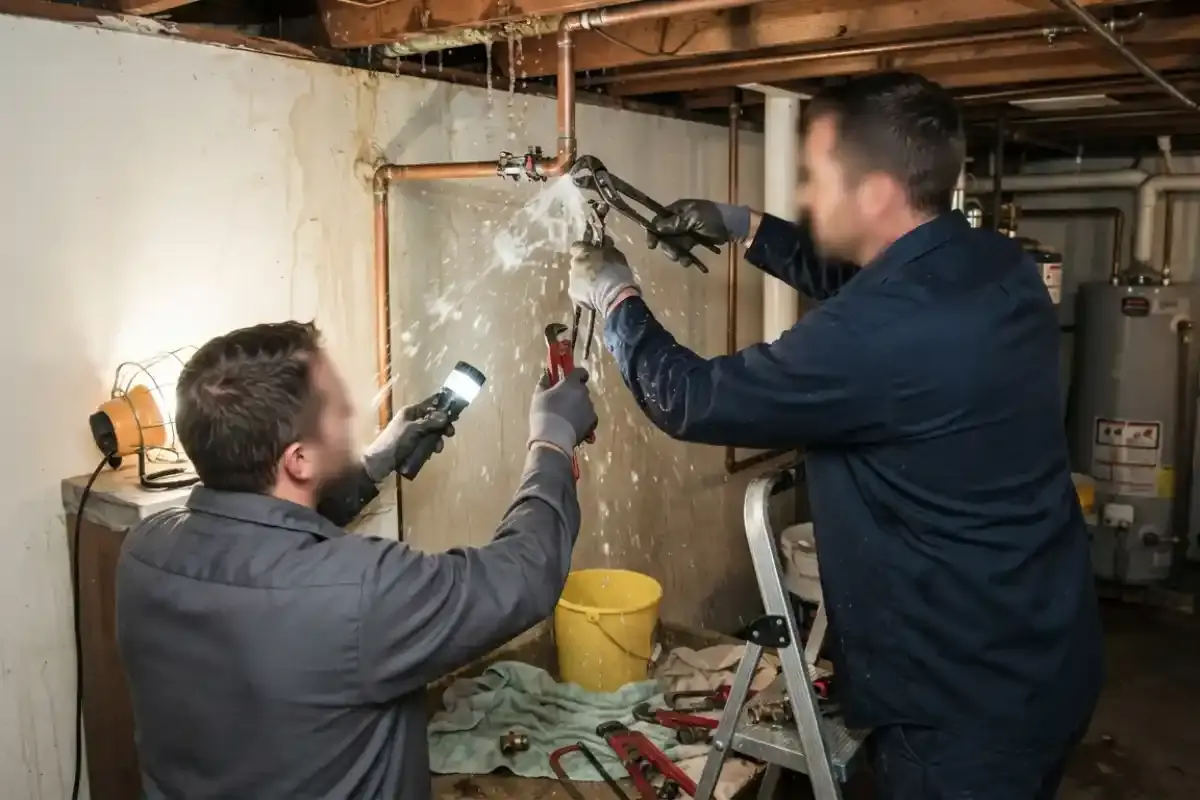
Burst pipe right now: the first ten minutes
Find the main shutoff first. It is usually a round gate valve or a lever ball valve where the line enters the house, or a valve in the meter box near the street. Turn a ball valve a quarter turn so the handle sits crosswise to the pipe, and turn a gate valve clockwise until it stops.
Open the lowest faucet to drain the line, then the highest to let air in. If the valve will not move, do not force it with a pipe wrench. Call us, and call Water Distribution at (407) 571-8340 if the problem is at or before the meter.
While you wait for the plumber
Shut off water at the main
Confirm by checking the meter dial. If it stops, the burst is on your side of the meter.
Power down wet circuits
Switch off breakers that feed rooms with standing water, but only if the panel is dry and you can reach it safely.
Contain the water
Use towels, a wet vac, or mop and bucket to keep water from reaching other rooms. Lift furniture legs onto foil or blocks.
Shut off the water heater
Turn off the gas or breaker so a drained tank does not overheat or fire dry elements.
Photograph everything
Capture damaged pipe, wet drywall, and belongings before you clean up.
After-hours calls reach (407) 964-8940 directly, and same-day appointments are available when we are not already on an urgent job.
What makes a pipe burst
Most bursts come from one of four things: a worn fitting, corrosion, too much water pressure, or a hard impact. Home water pressure should sit near 50 to 60 psi. A regulator that fails high can push a weak joint past its limit with no warning.
Cold snaps can freeze water inside exposed lines and split the pipe wall, though the split often only shows once the ice thaws. Attic runs, garage walls, and outdoor hose bibs are the usual places. Shifting soil and tree roots can crush a buried line, which we cover under water line repair.
Repair methods by pipe material
The right repair depends on what the pipe is made of and how much of it is damaged.
| Pipe | Common failure | Typical repair |
|---|---|---|
| Copper | Pinhole corrosion, split from freezing, loose solder joint | Cut out the damaged section and sweat in new copper with fittings |
| PEX | Cracked fitting, UV damage, kink, or rodent chew | Replace the fitting or splice with crimp or expansion couplings |
| CPVC | Brittle crack at fittings or from heat | Cut and replace with fresh solvent-cemented sections |
| Galvanized steel | Rust-through at threads | Replace the section, often with a transition to copper or PEX |
| Cast iron or PVC drain | Cracks, separated joints, or root intrusion | Cut and replace the section with a no-hub coupling or glued PVC |
Cracked drain and supply lines inside walls
A drain pipe leak only shows when something drains, which can make it hard to catch. A supply line leak runs constantly under pressure and soaks fast. We open the smallest section of drywall possible and use a moisture meter to track the edge of the damage.
If the pipe fails twice in one season, we look for the cause behind the fitting: pressure, corrosion, or water chemistry. Several failures in one home often mean the whole supply system is aging, and a repiping project may cost less than a string of repairs.
Replacement pipe and fittings should match the IPC-derived plumbing chapters Florida enforces. A permit may apply to larger replacements, so ask the City Building and Fire Safety Department.
Documenting damage for insurance
Your insurer will ask for evidence. Collect it before cleanup begins and again when it ends.
- Date-stamped photos or video of the burst pipe, the spray, and the water level.
- Close-ups of wet drywall, flooring, cabinets, and ceilings.
- A list of damaged belongings with approximate value.
- A copy of the plumbing invoice showing the repair and the date.
- Notes on when you noticed the leak and when you closed the main.
- Receipts for fans, dehumidifiers, or hotel stays tied to the loss.
When flood water is not a plumbing problem
The Little Wekiva River, which runs through Altamonte Springs, hit record flood levels during Hurricane Ian on September 29, 2022, and it overflowed again in Hurricane Milton on October 14, 2024. River or rain flooding is not a burst pipe, and it is not a plumbing repair job. If water is entering from outside, call the county or city, avoid electrical panels, and call us afterward for any supply or drain damage.
Flooding can also loosen fittings and push debris into lines. After a flood event, ask us to pressure-test supply lines and check your hose bibs, since a small crack found early is cheaper than a second water loss. Homes in Lake Mary get the same post-flood check from us.
What a burst pipe repair costs
The price follows the pipe type, the length, and the access, plus time of day for after-hours calls.
| Repair | Typical ballpark |
|---|---|
| Fitting or short section repair | $200 to $600 |
| Section replacement in a wall | $400 to $1,200 |
| Whole-run replacement | Quoted per job |
- Pipe material and sizeCopper and large-diameter pipe cost more in material and labor than short PEX runs.
- AccessAn exposed garage or utility room run is quicker than a pipe inside a finished wall.
- Length damagedOne cracked fitting is a small fix. A whole ruptured run needs more pipe and more time.
- After-hours timingNights, weekends, and holidays can be priced differently from a daytime same-day visit.
Treat those figures as typical ballparks, since a real job can land above or below them. You hear the actual price before we pick up a tool. For larger replacements, the permit question is yours to check with the City Building and Fire Safety Department at (407) 571-8446 for larger replacements.
What we do and do not fix
We repair supply and drain pipes, shutoff valves, and connected fittings. We do not dry out walls or rebuild flooring, so for a big loss you will want a restoration company too. If the leak is a small drip at a faucet or valve, our faucet and valve repair service may be the closer match.
Anyone smelling gas should leave and call 911.
Burst pipe questions
Yes. (407) 964-8940 is answered every hour of every day. Close the main shutoff, then call, and we will send the first available technician, including overnight and on weekends.
Look for a valve where the line enters the house, often near the water heater or an exterior wall, or in the meter box at the street. If you cannot find it, the valve in the meter box is controlled by the city, so call Water Distribution at (407) 571-8340.
Push-fit couplings and clamps can slow a leak for a short time. They are a stopgap, and a soldered or crimped repair by a plumber lasts for decades.
We cut access holes as small as we can and leave the pipe repaired and tested. Drywall patching and painting are usually handled by a drywall contractor.
Open the faucet slightly so water has a path, and warm the pipe slowly with a hair dryer. Never use an open flame. If the pipe is bulging or leaking, shut off the main and call us.
Many policies cover sudden bursts and the resulting water damage, though not slow leaks. Check your policy and keep the repair invoice and photos.