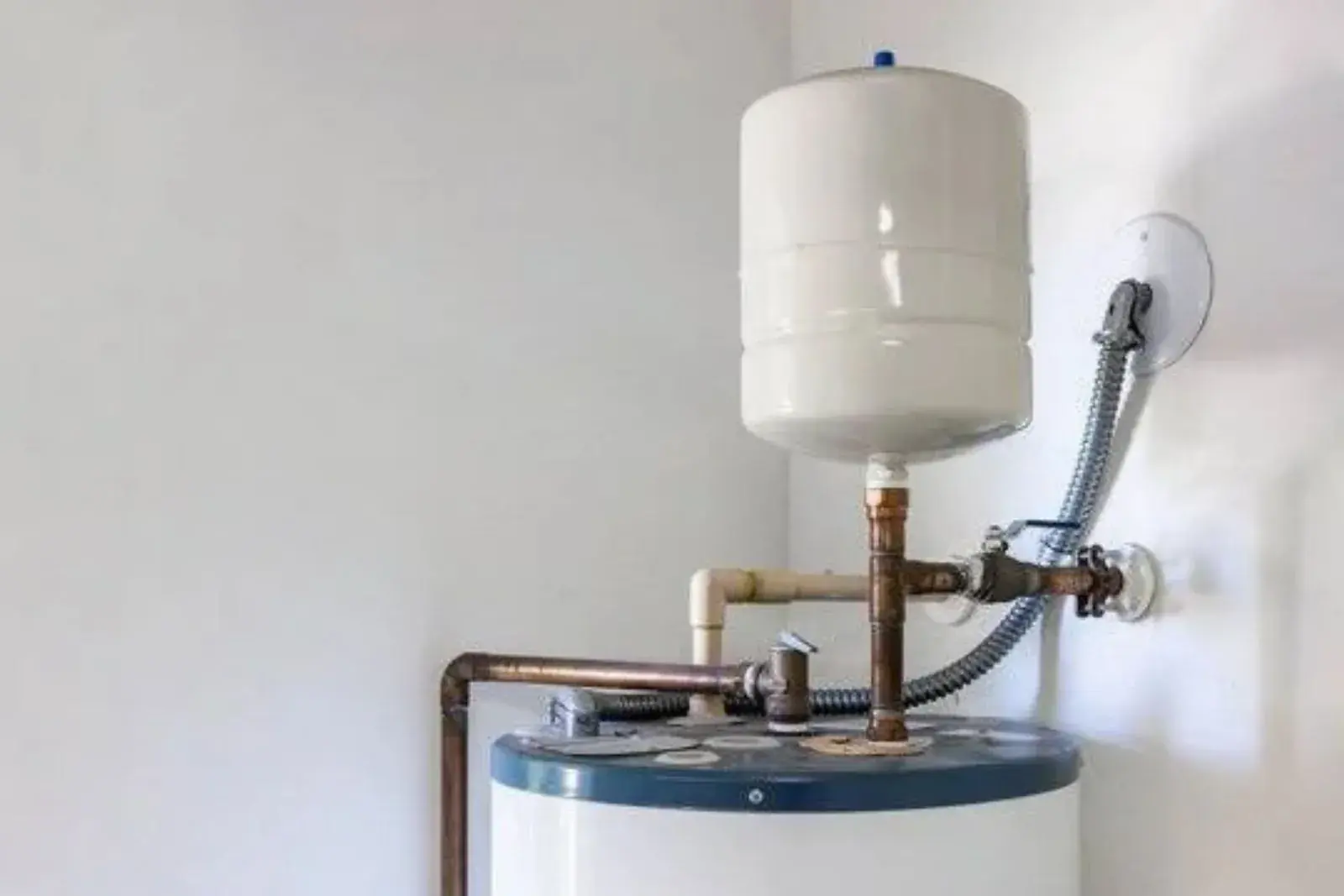
Why heated water needs somewhere to go
Water grows when it gets hot. Heating it from about 50 degrees to 140 degrees expands it by roughly 2 percent. In a 50 gallon storage tank that is around a gallon of extra water looking for room.
In an open system, that extra volume pushes back into the city main and nobody notices. In a closed system, there is nowhere for it to go. Pressure in the pipes spikes each time the heater fires, and the weakest part gives way, usually a relief valve, a fixture seal, or a supply line.
Open and closed systems explained
A system becomes closed when something on the supply side blocks backward flow. The common culprits are a check valve, a backflow preventer at the meter, or a pressure reducing valve (PRV) with a built-in check. Each lets water in and refuses it back out.
Many newer homes have one or more of these. Older houses with a plain shutoff and no check may still be open. The only sure way to tell is to look at the supply line near the meter and the main shutoff, then test the pressure.
Tank, tankless, and expansion: how they compare
The table below shows why a storage tank is usually the one that needs the vessel, and why tankless is the exception that deserves a quick check.
| Situation | Expansion tank? | Reason |
|---|---|---|
| Storage tank on a closed system | Yes, very likely | Dozens of gallons expand with nowhere to go |
| Tankless on an open system | Usually no | Small water volume, supply can absorb the change |
| Tankless on a closed system | Check the manual | Some manufacturers still call for one |
| Tankless with a recirculation loop or buffer tank | Often yes | More stored, heated water, more expansion |
| Tankless with a PRV that has a built-in check | Check the manual | The PRV may close the system |
Signs your hot water system is trapping pressure
These are the clues a plumber looks for before deciding on a tank. None proves it alone, but a few together point to a trapped-pressure problem.
- Water drips from the relief valve discharge pipe each time the heater cycles.
- A banging or thumping sound travels through the pipes right after you shut off a faucet.
- The static pressure at an outdoor spigot gauge reads above 80 psi.
- Faucet or toilet fill valves seem to wear out faster than they should.
- A new or recent check valve, PRV, or backflow preventer was installed near the meter.
- Supply connectors under sinks bulge or weep at the nut.
How to test your own pressure
Buy a screw-on water pressure gauge at a hardware store, usually under 15 dollars. Thread it onto a hose bib while the house is quiet, then read the number. Many plumbers consider 40 to 60 psi comfortable, and anything above 80 psi is a reason to call.
Next, run hot water until the heater fires and watch the gauge climb. If the needle creeps up several psi while the unit heats, expansion is going somewhere it should not. Write down the numbers for the plumber, since they speed up the diagnosis.
What the expansion tank actually does
A thermal expansion tank is a small steel vessel with a rubber diaphragm inside. One side holds air, charged to match your home's water pressure, usually around 40 to 60 psi. The other side connects to the cold line near the heater.
When heated water expands, it pushes into the tank and compresses the air cushion. When the pressure drops, the air pushes the water back out. The tank is passive, with no power and no controls, which makes it a cheap, reliable fix.
Sizing and charging
Tanks come in sizes such as 2 gallon and 4.5 gallon. The right size depends on the volume of heated water and the house pressure. The air charge must match the supply pressure with the tank disconnected from water, or it will not work properly.
Mounting
Smaller tanks may hang from the pipe, but larger ones need a support strap or bracket. Vertical mounting with the connection at the bottom lets a failed diaphragm drain safely.
What Altamonte Springs homeowners should know about expansion and backflow
The City of Altamonte Springs supplies drinking water, and its Water Distribution office, reachable at (407) 571-8340, maintains the pipes, valves, and meters that deliver water to your property. Florida rule 62-555.360 requires community water systems to run a cross-connection control program, and it sets testing intervals for backflow preventers: at least annually for non-residential and at least every two years for residential.
Those rules are about protecting the public supply. Whether your own home has a backflow device at the meter is a question for the city or your plumber. Ask before you buy a tank, because that one fact tells you whether your system is closed.
Thermal expansion is addressed in the International Plumbing Code (IPC), and Florida adopts that code in the Florida Building Code, Plumbing. Ask your installer how the code applies to your setup.
What a plumber does during an install visit
A technician will read the water pressure, look for check valves and a PRV, and inspect the temperature and pressure relief valve. If the system is closed, the plumber picks a tank sized for your heater, sets the air charge, and tees it into the cold line.
For tankless units the plumber also confirms what the manufacturer requires, since the warranty may depend on it. Work like this is part of a normal water heater installation and often goes together with new plumbing installation work in a remodel. Permit questions go to the City Building and Fire Safety Department at (407) 571-8446.
Problems an expansion tank can and cannot fix
A tank solves thermal expansion, nothing else. It will not cure a water heater that leaks from a rusted shell, a bad thermostat, or a failed heating element. Pressure that is too high at the street needs a PRV set to a lower number.
If your relief valve is already weeping, a water heater repair visit can tell whether the valve is bad or the pressure is climbing. Homeowners in Longwood and Winter Springs can call the same 24/7 line for a pressure check.
Replacing an old expansion tank
These tanks do not last forever. The diaphragm can tear, or the air charge can leak away. A simple check is to press the air valve with a small tool. If water comes out, the diaphragm has failed and the tank is waterlogged.
You can also tap the tank. A healthy one sounds hollow on top and solid at the bottom. A waterlogged one sounds solid all over. Many plumbers suggest checking the air pressure once a year, with the tank isolated and drained first.
Expansion tank questions
No. Many installs on open systems do not need one. If your plumbing has a check valve, a PRV, or a recirculation loop, read the manufacturer's manual and ask your plumber.
Look for a backflow preventer, check valve, or PRV near the main shutoff. A pressure gauge on a hose bib that climbs when the heater fires also points to a closed system.
No. It is a small steel vessel with a rubber diaphragm and an air cushion. It does not heat or store hot water for use.
Pressure spikes each time the heater cycles. The relief valve may drip, fixtures wear faster, and connections can leak over time.
The City of Altamonte Springs supplies the water, and its Water Distribution office is listed at (407) 571-8340. Permit questions go to the Building and Fire Safety Department at (407) 571-8446.