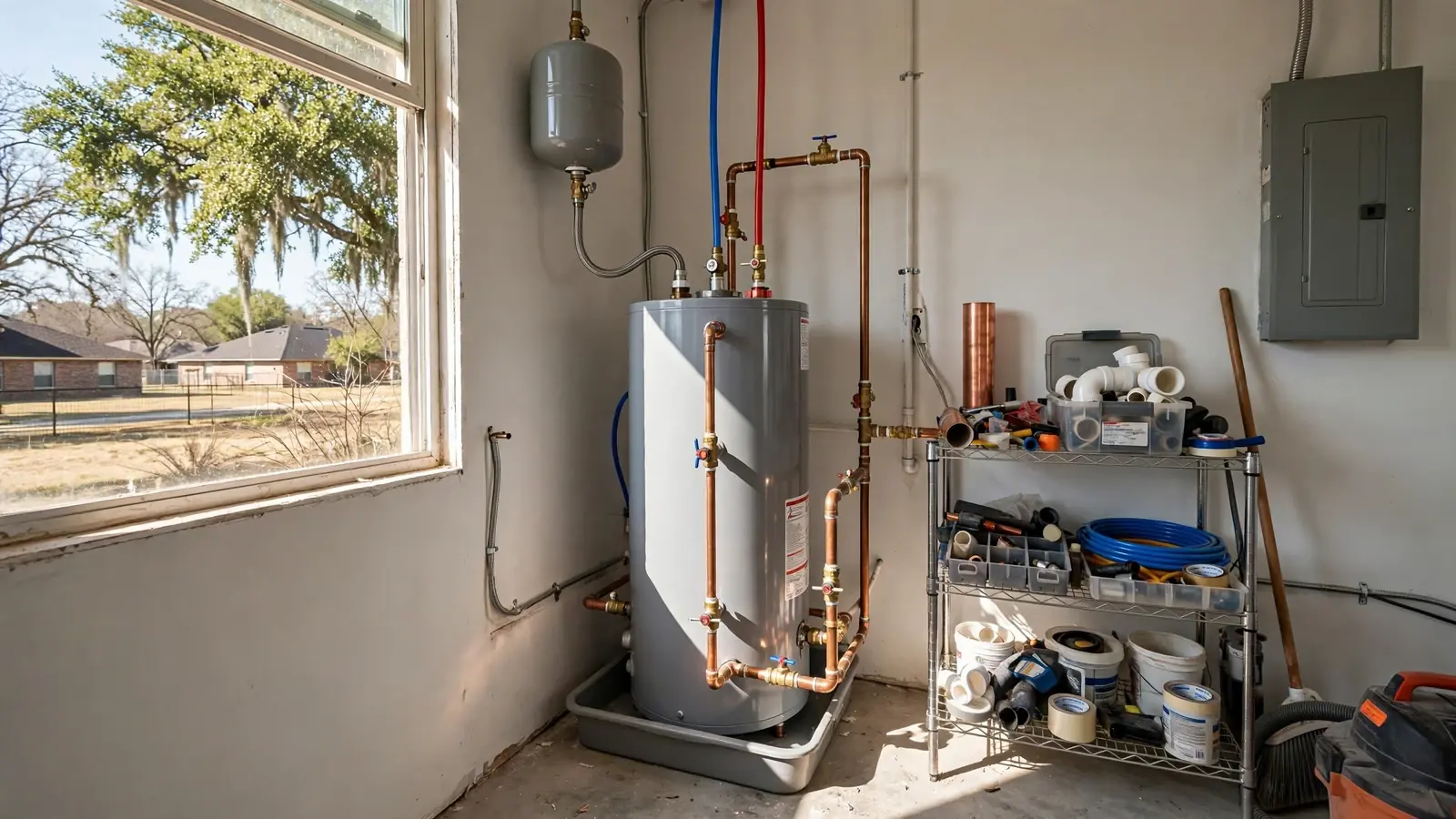
What we confirm before we set a new tank
We measure the space, read the old heater's label, and check what already feeds it. That means the gas line size, the circuit breaker, the flue or vent run and the shutoff valves on the water side. Each of those can change the price, so we look at them first.
Next we decide on capacity. A 40-gallon tank suits one or two people, a 50-gallon unit fits most families of three or four, and larger homes may want 80 gallons or a hybrid. The right answer depends on your showers and laundry habits, not on square footage alone.
Venting, gas and electrical: three connections that decide the job
Venting
A gas tank must exhaust combustion gases outside through a correctly sized and sloped flue, and it needs air to burn. Power-vent and direct-vent models use fans and PVC pipe, so they can go in places a standard flue cannot. We check clearances around the burner and the draft hood on every gas install.
Gas supply
The gas line needs a shutoff valve, a drip leg or sediment trap, and a flexible connector rated for the appliance. We test every joint for leaks before lighting. If a gas smell shows up at any time, leave the house and call 911.
Electrical supply
A standard electric tank runs on a 240-volt, 30-amp double-pole circuit. Hybrid heat pump models may need a dedicated circuit and a nearby drain for condensate. If the panel has no room, an electrician handles the panel side and we handle the heater.
Expansion tank and relief valve: the parts that protect the plumbing
Water expands about 2 percent as it heats from cold to hot. In a closed system, with a backflow device or check valve on the meter side, that extra volume has nowhere to go and pressure spikes. A small expansion tank, charged to match your house pressure, absorbs it.
Every tank also needs a temperature and pressure relief valve with a discharge pipe that runs downhill to a safe spot. We test house pressure with a gauge at the hose bib. Anything above 80 psi gets a regulator conversation, because high pressure shortens the life of every fixture and appliance in the home.
Install options side by side
Picking the type is the biggest decision of the visit. This table shows how the common options differ, and our tankless water heater page goes deeper on the wall-mounted choice.
| Option | Best for | Install needs |
|---|---|---|
| Gas storage tank | Homes with a gas line and a vent path | Flue, gas valve and trap, combustion air |
| Electric storage tank | Closets, attics and homes without gas | 30-amp 240-volt circuit, drain pan |
| Hybrid heat pump tank | Electric homes that want lower power use | Open air space, condensate drain, dedicated circuit |
| Tankless gas or electric | Small spaces and steady supply needs | Venting or heavy circuit, isolation valves |
Getting the space ready for the crew
A little prep saves time on the day of the install.
- Clear 3 feet in front of and around the heater.
- Move stored items and clean up around the old tank.
- Tell us where the main water shutoff is.
- Locate the breaker panel and mark the heater circuit.
- Point out any past leaks or odd noises.
- Ask your association about install rules if you live in a condo or townhome.
- Decide where the discharge pipe can safely drain.
Permits and code: who to ask in Altamonte Springs
The city's Building and Fire Safety Department handles permits at (407) 571-8446. Its permit list includes a stand-alone plumbing type for work that does not need plans. Whether a water heater install needs one is not something we can state from the pages we reviewed, so ask the department before the work starts.
Plumbing work in Florida follows the Florida Building Code, Plumbing, 8th Edition (2023), which is based on the 2021 International Plumbing Code. The analysis of changes for that edition touches temperature-limiting rules in sections 607.1.1 and 607.1.2. We install to the code, and you can ask us what applies to your heater.
New construction and remodel plumbing for the heater
In a new build or gut remodel, the heater is roughed in before the walls close. The plumber runs hot and cold stubs, a gas drop or electrical home run, a drain for the pan and a path for the relief discharge. Getting those right in the framing is much cheaper than cutting drywall later. For work that goes beyond the heater, see our plumbing installation service.
What drives the price of a new water heater install
The heater is only part of the bill. These items change the total most.
| Install scope | Typical ballpark |
|---|---|
| Standard electric tank, like for like | $1,400 to $2,400 |
| Standard gas tank, like for like | $1,600 to $2,800 |
| Hybrid heat pump tank | $3,000 to $4,800 |
| Expansion tank add-on | $150 to $350 |
- Type and capacityHybrid and high-efficiency units cost more than a basic 40 or 50 gallon tank.
- Venting changesNew flue or PVC vent runs add materials and labor.
- Gas or electrical workLonger gas lines or new circuits add parts and time.
- Code itemsPans, expansion tanks, valves and discharge pipe lengths vary with the space.
- LocationGarages are quick. Attics and second-floor closets take longer.
These are typical ballparks that change with the job. You hear the price clearly before work starts, and nothing begins until you agree.
Altamonte Springs conditions that shape an install
The city draws groundwater from the Floridan aquifer, and its water report we reviewed does not publish hardness. A hardness test strip from the store costs a few dollars and tells you whether a flush plan or filter makes sense for your new tank.
The city also lists 97 multifamily communities, so a condo or apartment heater may sit in a shared closet with association rules. Ask the board before ordering a unit. We also install for Winter Springs homes in Tuscawilla and Town Center when the schedule allows.
Limits, and what happens if the old heater fails first
We do not upgrade electrical panels or run new gas mains. We also do not install units that your property manager or association has barred. If the old heater leaks before the install day, our water heater replacement service is the faster path, and the 24/7 line is open for that.
A gas smell is a 911 call first. After that, call the gas utility number on your bill.
Water heater installation questions
It depends on whether the plumbing is a closed system. A backflow device or check valve on the water line closes it, and then an expansion tank is the safe choice. We check your pressure and set-up on the visit.
A like-for-like swap often takes a few hours. Venting changes, new gas lines or moving the heater to a new spot add time, and we give you that plan first.
Often yes. The new spot needs access to water, a vent path or a power circuit, a drain for the pan and clearance around the tank. We lay out the plan before pricing.
That depends on your gas and electric rates, which change. Compare both utility bills and the heater's efficiency labels before you choose.
Ask the City Building and Fire Safety Department at (407) 571-8446. We do not state a rule that is not confirmed on the city pages we reviewed.
Same-day appointments are offered when the schedule allows. The 24/7 line at (407) 964-8940 is the way to ask.