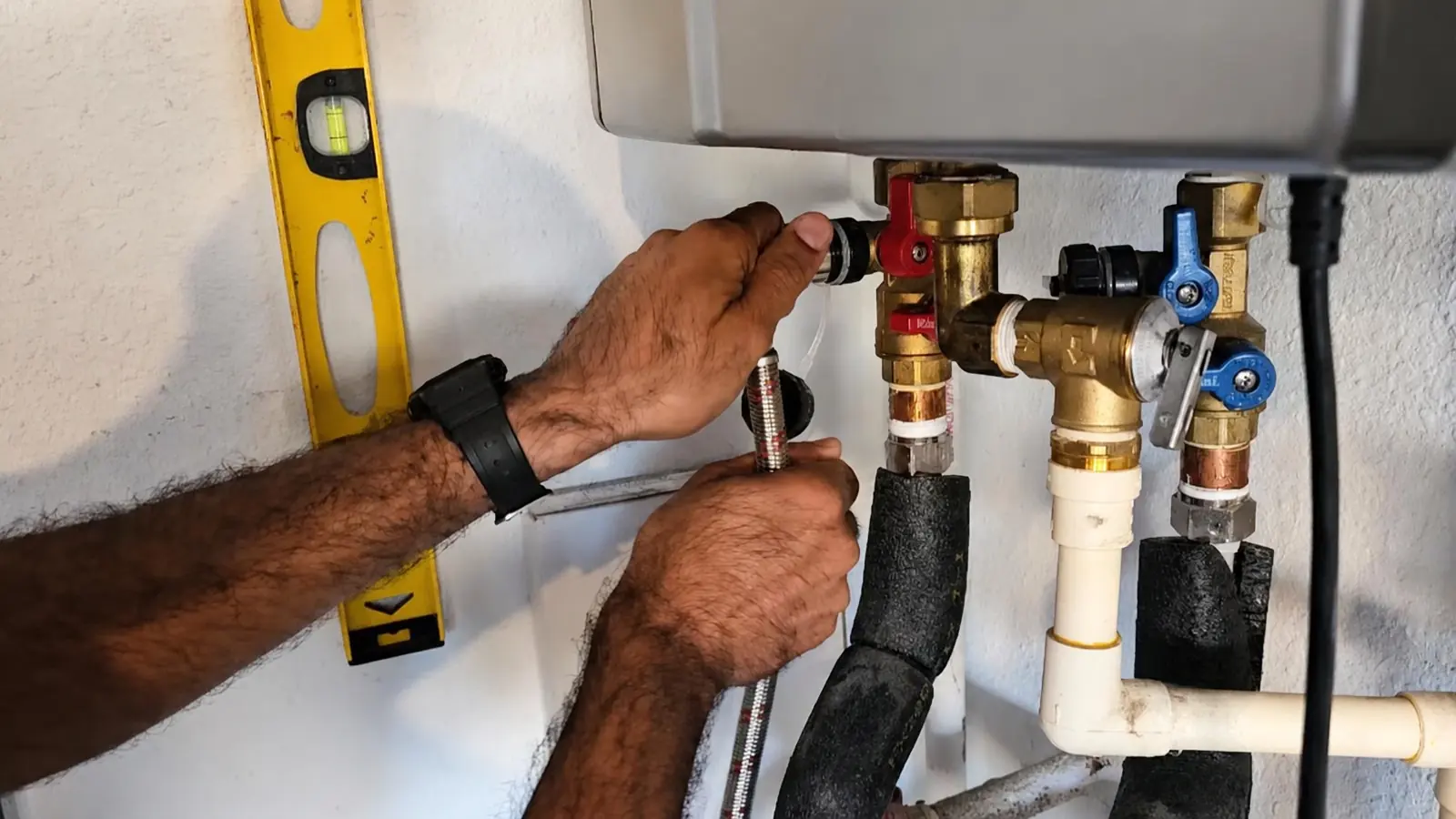
Why 120 degrees is the usual answer
Burn risk climbs fast with temperature. A commonly cited safety figure is that water at 140 degrees can scald adult skin in about five seconds, while water at 120 degrees takes several minutes. Children and older adults have thinner skin, so their margin is smaller.
A tankless unit heats water as it flows, so the number on the display is the temperature at the heater, not at your faucet. Long pipes lose a few degrees on the way. At 120 you still get a comfortable shower at nearly every fixture in a typical single-story house.
Setting by setting: what each temperature does
Use this as a starting point, then adjust five degrees at a time. Most electronic controllers move in steps of 5 degrees, and many units offer anything from about 100 to 140 on the standard remote.
| Setting | Best for | Watch out for |
|---|---|---|
| 100 to 110 F | Households with toddlers who want the lowest risk | Showers may feel lukewarm, mixed water at the tap runs cooler |
| 120 F | Most homes: showers, baths, sinks, laundry | Some dishwashers prefer a booster heater for a hotter final rinse |
| 130 F | Long pipe runs, a far-away bathroom, a large tub | Scald time drops sharply, add a mixing valve or anti-scald fixtures |
| 140 F | Special cases only, such as a dishwasher with no heater | Burns in seconds, tempering valve strongly advised at the tap |
How to change the temperature on the unit
Look at the front panel or the small wired remote. Many units show the set point in degrees and let you press up or down. Some models have a dial or small switches inside the cover, so read the label on your model before opening anything.
Make the change, then run hot water at the nearest tap for about a minute and test the stream with a thermometer. Wait a minute between adjustments, because a tankless unit needs a moment to settle on a new set point.
Gas units
A gas tankless heater has a burner and a vent. Changing the set point is a control-panel task, but any work on the gas line, burner, or vent belongs to a licensed plumber. If you smell gas at any time, leave the home, call 911, then call the gas company listed on your bill.
Electric units
Electric tankless heaters draw a lot of current, often on dedicated breakers. Changing the set point on the display is fine. Never open the electrical compartment with the breaker on.
Check these before you raise the setting
A tankless unit that seems too cool is often not a set point problem at all. Run through this list first.
- Confirm the hot water valve at the unit is fully open and the cold supply is on.
- Check the flow rate. Many units need roughly 0.5 gallons per minute to fire, and a fixture below that can leave you with cold water.
- Clean the inlet screen or filter on the unit, since sediment can restrict flow.
- Look for an error code on the display and match it to the manual.
- Test at more than one fixture. If only one faucet is cool, the problem may be that fixture, not the heater.
- Check whether a recirculation pump or a blended-in cold crossover line is feeding cold water into the hot side.
Scald protection that works at any setting
A mixing or tempering valve blends hot and cold water so the pipes to your fixtures never carry more than a set maximum. It is the cleanest way to run a hotter heater for a dishwasher while keeping showers safe. Anti-scald shower valves limit the hot side in a similar way right at the fixture.
Florida's plumbing code has a recent change in this area. The state's published analysis of changes to the 8th Edition (2023) Florida Building Code, Plumbing lists updates to sections 607.1.1 and 607.1.2 about temperature-limiting devices, including mixing valves and heaters that meet certain ASSE standards. Ask your installer how those sections apply to your particular job.
Do you need a higher setting to kill germs?
Legionella is a bacterium that can grow in warm, stagnant water. General public-health guidance points to stored water kept warm for long periods as the main concern, which is why tank heaters are often discussed at 140 degrees.
A tankless heater stores very little water, so the same worry applies less. Still, if someone in your home has a weakened immune system, ask a doctor or your plumber about the right setting and any mixing valve before you pick a number. Do not guess on this one.
When you can adjust and when to call a plumber
Changing the set point is a homeowner task. The following jobs are not: a unit that never reaches the set point, an error code that returns after a reset, water that swings hot and cold mid-shower, or any smell of gas or burning.
A technician doing a water heater installation or service call can flush scale from the heat exchanger, test gas pressure, check the flow sensor, and verify that the venting is clear. If the cold-water sandwich effect is the issue, a small recirculation setup or buffer tank may be the fix, not a higher number. If you are weighing a swap, a tankless water heater installation visit can size the unit to the number of fixtures you run at once.
What Altamonte Springs homeowners should know about hot water settings
The City of Altamonte Springs supplies drinking water drawn from the Floridan aquifer, and it publishes an annual drinking water quality report. Hardness is not stated in the sources we reviewed, so test your own tap or ask the city's Water Distribution office at (407) 571-8340 before you decide on scale protection.
That matters for your setting, because mineral scale makes a heat exchanger work harder and can make the unit seem unable to reach its number. Check the report, then plan a yearly flush.
Sizing the setting to your household
A family that runs a shower, a dishwasher, and a washing machine together asks more of a tankless unit than a couple using one shower. When flow demand exceeds the unit's output, the water cools even though the set point is unchanged. The fix is a bigger unit or staggered use, not 140 degrees.
Rinse temperature on a clothes washer is usually a tap setting inside the machine, not something your heater controls. For a dishwasher, check the manual, since many modern models heat water internally and run fine on a 120 degree supply. If you also use the hot line for a pool heater tie-in or a long outbuilding run, a plumber should look at the layout.
Homeowners in Casselberry and Lake Mary can call the same 24/7 line for sizing and setting help.
Yearly care that keeps the number accurate
Scale builds up inside the heat exchanger and narrows the water path. Many manufacturers recommend a descaling flush with a food-grade vinegar or approved solution, often once a year, and more often in homes with hard water. Check your manual for the interval.
Clean the inlet filter, test the relief valve if your model has one, and keep the area around the unit clear. A tankless heater that was set to 120 and now delivers 105 is telling you it needs service.
Tankless temperature questions
No. Most households run comfortably at 120. If the water feels cool, check flow rate and demand first before raising the number.
Many units allow it, but scald time drops to a few seconds at that temperature. If you need 140 for a specific appliance, add a mixing valve so your faucets and showers stay lower.
The display shows the heater's output. Pipe length, cold pipes, and a fixture that mixes in cold water all lower what you feel. Test at the tap with a thermometer.
Incoming water is warmer in summer, so the unit works less hard to reach the same set point. You normally leave the setting alone and only change it for comfort.
The City of Altamonte Springs supplies the water and publishes an annual drinking water quality report. For distribution questions, the city lists Water Distribution at (407) 571-8340.